Crocheting a Suet Feeder
In which the author devises a way to feed birds without enticing local mammalia.
I'm not saying I have a raccoon problem. I am, however, saying that they've made it hard to keep track of my traditional metal suet feeders. Also, it's possible that the raccoons are completely innocent (they're not) and that it's squirrels that are to blame (maybe).
Over the past several years, I've hung up the little green wire cages from the maple tree in my front yard. The woodpeckers loved them, the smaller birds that are typically content with seeds seemed to appreciate them, and, given the opportunity, the European starlings would descend as a horde and decimate their contents in no time flat.
Squirrels would jump down onto the cages, and on a few occasions launch themselves at them from ground level.
More than once, a cage would disappear overnight. I'd find it eventually in some other corner of the yard.
For a while, I discontinued suet feeder usage entirely. It's not necessary in the warm months, when bugs with their fat and protein content are more readily available. And blocks, unless they're the special "no-melt" variety, are prone to becoming a goopy mess in the hot summer sun.
In winter, between the squirrels and starlings, my stores would run out sooner than I would have liked.
And so, I stopped.
Until last Christmas, when my sister's boyfriend gifted me a brand new cage and some Audubon brand blocks in different ingredient combinations (the bird featured on one of the packages was a great spotted woodpecker; it's not clear if that was an egregious mistake or if the same suet blocks on sale in Ohio are sold in European markets).
Up the new cage went, with the Audubon blocks going in one by one until I replaced them with more generic grocery store SKUs.
And then someone knocked the cage down.
I saw it lying on the bank beside my brush pile (another fine feature for attracting birds and other wildlife), always in passing while I undertook other excursions or chores. Because it was out of the way or I was otherwise occupied and wasn't motivated to deal with a winter bird feeder solution, it stayed parked there for Quite Some Time.
And then it was gone.
Or misplaced. I haven't ruled that possibility out completely yet.
I feel terrible, of course, mistreating a thoughtful gift. My best excuse is that it's been a rough year and my executive function has been largely absent throughout most of it.
But now it's winter. The birds are hungry and the bugs aren't nearly as plentiful. My cat is bored and needs something to look at as she sits by the window in the mornings. And I still have suet blocks left over from when I still knew where my suet cage was.
So: I wanted to put out suet again.
First, I found a thin, manufactured mesh bag from some purchase or other. My hope that it would work was quickly abandoned after one day. The holes were too tiny for larger bills, and the mesh fabric was so unsubstantial, there was no way for a bird to safely grip it while eating.
Fair enough.
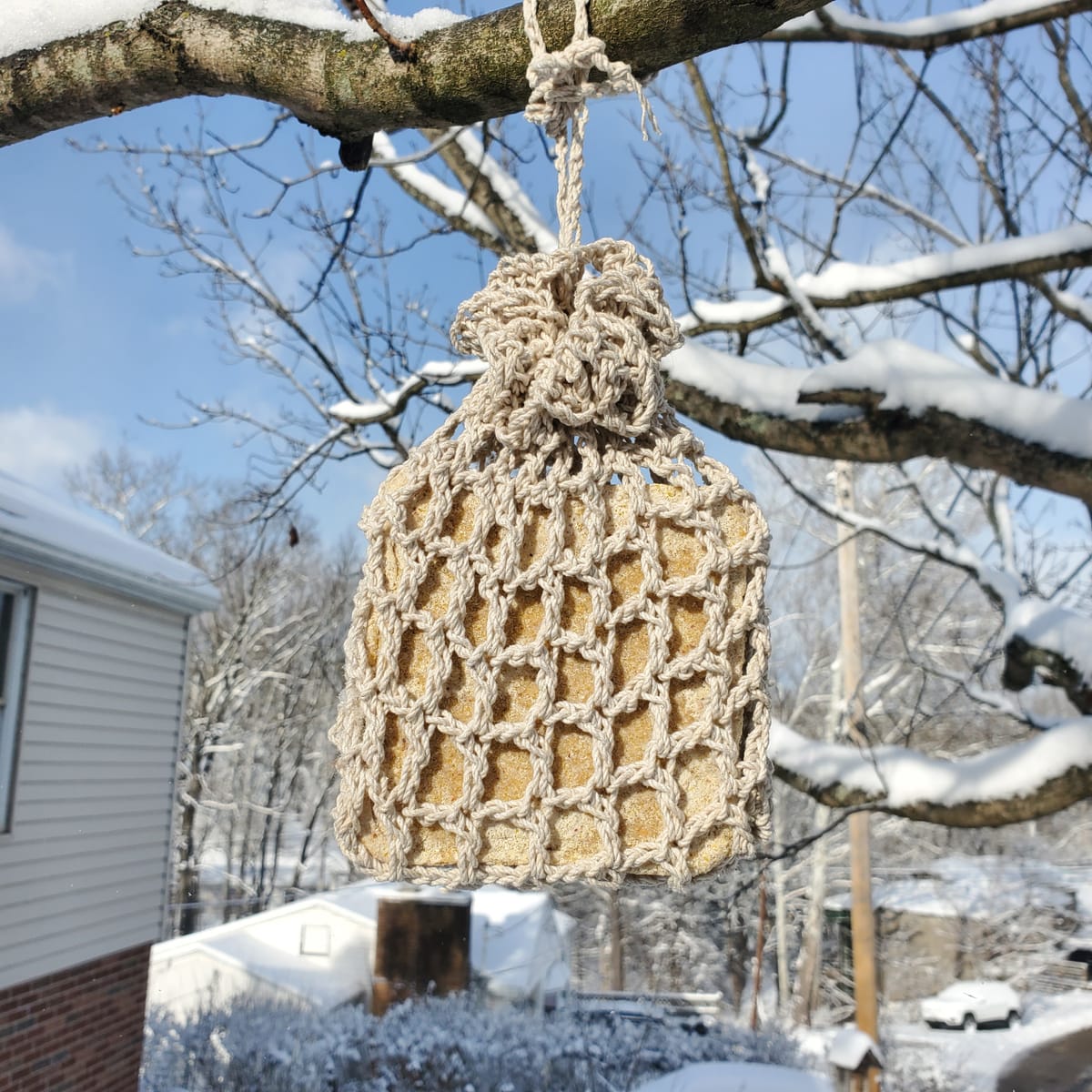
The next night, I dug out some slender cotton cord, a few cakes of which I purchased from a seller of sundries at our local weekend flea market for $1 apiece, as well as a larger-caliber crochet hook. I pulled out one still-packaged suet block, chained to just past the length of the square, and started making double-crochet stitches into every third stitch, working my way around both sides of the chain.
A few rounds later, a had a squarish mesh bag that little bird toes could grip.
I took the granny square approach of packing three double crochet stitches into each two-chain space, creating some ruffle-like volume to seal up the top once the hanging cord was installed. That cord was just a long line of chain stitches, fed through the last row of mesh, pulled tight and tied to test. I barely bothered with weaving in the loose ends.
The next day, I took down the manufactured mesh bag that hadn't worked (although a chickadee had pondered it briefly from a branch above), slipped the suet block out of the failed attempt and into the new handmade one, cinched it up, and tied it onto a branch adjacent to my hanging platform feeder. Lark's head knotted it, in fact.
It took a few days, but a tufted titmouse finally broke the seal in checking the new bag out. The fella clung to an upper corner and pecked at the contents. Success.
I've also watched some house finches consider it, trying to figure out how to approach and land on it correctly from the ground and from the tree. I'm unsure if the cord might be a little too short, or if it's still too novel for them, or if maybe tufted titmice manage better in-air maneuvers for this sort of thing. Dunno.
I'll keep checking the progress of the block, though, to see how quickly it's eaten. The starlings haven't found it yet, and I haven't seen any clues indicating raccoon behavior.
It's nice to know that this is a fast, cheap, biodegradable option, in the event this crocheted cotton cage disappears or needs to be decommissioned in the interest of cleanliness.
Hooray, silly and cozy winter projects.